Media Release

Inuit Respond to Federal Government’s Northern Strategy: Partnership with Inuit Should be Strengthened

Tuesday July 28, 2009 - Ottawa, Ontario - Inuit Tapiriit Kanatami (ITK) responded today to this week’s federal government’s release of its promised ‘Northern Strategy’.

“In developing and releasing this Northern Strategy the federal government has calculated - correctly - that the Arctic will be of increasing domestic and international importance in the years ahead”’, said national Inuit leader Mary Simon. “All sorts of factors, ranging from climate change, to new transportation and resource proposals, to the growing awareness of the central importance of the rights of indigenous peoples, are pushing the Arctic agenda forward. The federal government is right in focusing its attention Northward.”

President Simon said that the four priorities identified in the Strategy (exercising Arctic sovereignty, protecting environmental heritage, promoting social and economic development, and improving and devolving Northern governance) are broad enough to serve as a practical way of mobilizing greater federal government investment and policy effort. There is, however, one priority missing.

“While the four priorities set out in this strategy are useful, they need to be accompanied by a fifth priority. That fifth priority should be a specific and direct relationship with Inuit in the four Inuit land claims regions, said Mary Simon. “And that relationship should be at the core of everything else that is being attempted in the Arctic. The four Inuit land claims agreement areas form a continuous chain defining Inuit rights and jurisdictional arrangements across the Canadian Arctic from the Alaska border to Nunatsiavut in Labrador. These land claims agreements recognize the Arctic as our ancestral and contemporary home in Canada. Others are welcome to work with us to develop our home to the mutual benefit of ourselves and of Canada, but development must be based on full respect and genuine partnership. Inuit are a hospitable people, but also a determined and fair-minded one.”

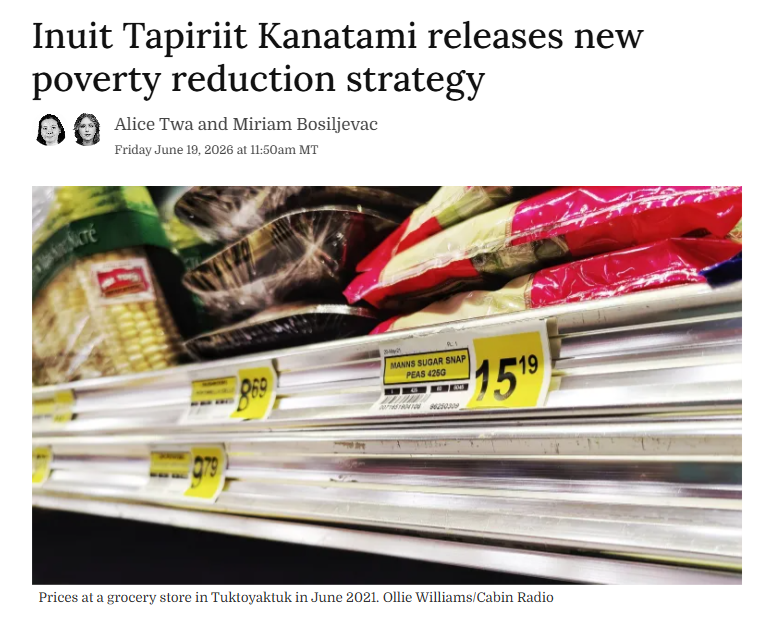
Mary Simon pointed to a number of strengths in the strategy from an Inuit perspective, including: acknowledgement that Canada’s strong presence in the Arctic is “due to in large part to contributions of Inuit”; recognition that infrastructure, such as housing and education, “require urgent attention”; the need to make appropriate military investments but also to recognize the opportunities for handling international affairs in the Arctic on a cooperative basis; the useful work of the Arctic Council; the positive precedents that have been struck in equipping aboriginal peoples with equity roles in major natural resource development projects; the importance of investing in such things as geo-mapping and environmental research; and the need to pursue both economic development and social development objectives in tandem. In relation to health and social issues, ITK welcomed the Strategy’s specific reference to ensuring that residents of “remote and isolated communities have access to good quality, nutritious food at affordable prices”.

President Simon also pointed to a number of areas, in addition to creating a stand-alone priority for INUIT partnership, where the Strategy could be strengthened, including: the re-casting of the Strategy as an Arctic as well as Northern Strategy, including all the land and marine areas governed by the four Inuit land claims agreement areas (Inuvialuit Region, Nunavut, Nunavik, and Nunatsiavut); the establishment of timelines for the elimination of gaps in basic well-being (housing, education, physical and mental health) between Inuit in the Arctic and Canadians in the South; additional investments, beyond those announced Sunday, in housing, education, including Inuit language, culture and knowledge, and health infrastructure; commitment to the full and fair implementation of all modern land claims agreements, and a willingness to reform land claims implementation policy along the lines recommended by both the Land Claims Agreement Coalition and the Senate Committee on Aboriginal Peoples; greater inclusion of Inuit researchers in International Polar Year research and a greater reflection of the human, social and cultural face of the Arctic in IPY research; an ambitious effort to upgrade small crafts harbours in addition to Pangnirtung; commitment to the headquartering of the new Northern Economic Development Agency in an Arctic community; and acknowledgement of the importance of the April, 2009, document adopted by the Inuit Circumpolar Conference, entitled A Circumpolar Inuit Declaration on Sovereignty in the Arctic.

“I have taken note of the document, and statements made by ministers at the launch of the Northern Strategy,” said Mary Simon. “Inuit find it unacceptable that a map labeled ‘Canada’s North’ on pages 6-7 leaves out all the Inuit communities in Nunavik – where I live – as well as those in Nunatsiavut (Labrador). While a renewed focus on the Arctic Council is welcome, the reinstatement of Canada’s Ambassador to the Arctic would also be a welcome development for Inuit.”

Contact:

Stephen Hendrie, Director of Communications
Tel: 613.277.3178, hendrie@itk.ca

(Media enquiries only.  General requests can be sent to info@itk.ca or you can visit our contact page for more ways to contact us.)

Stats2