
Inuit are an Indigenous people living primarily in Inuit Nunangat.
The majority of our population lives in 51 communities spread across Inuit Nunangat, the Inuit homeland encompassing 40% of Canada’s land area and 72% of its coastline. We have lived in our homeland since time immemorial. Our communities are among the most culturally resilient in North America. Roughly 60 percent of Inuit report an ability to conduct a conversation in Inuktut (the Inuit language), and our people harvest country foods such as seal, narwhal and caribou to feed our families and communities.
Learn more
Canadian Inuit are young with a median age of just 23.
This affects how our population interacts with the policies, programs and services targeting Inuit. Our population is also increasingly urban: more than 3,000 Inuit live in Ottawa alone.

Traditional values such as sharing, respect for elders and cooperation remain central to Inuit community life.
Despite our small population, Inuit communities have produced world renowned musicians and artists and our leaders have helped advance the global struggle for Indigenous self-determination and human rights. Today Inuit occupy a number of professions in the arts, medical field, government and academia.
T hese are some of the assets that reflect the resilience and potential of our people. However despite these positive characteristics too many Inuit face persisting social and economic hardship. Many families are struggling to meet their basic needs in areas such as safety, housing, and getting enough food to eat.
Statistics and research paint a distressing picture of our society, in which too many people are struggling with violence and trauma. These challenges exist against the historical backdrop of Canada’s colonization of Inuit Nunangat, in which federal government policy directed the institutions and systems that have destabilized our society by undermining our ability to be self-reliant. The social and cultural challenges that exist today can similarly be undone in large part through policies that support and empower Inuit institutions, families and communities.
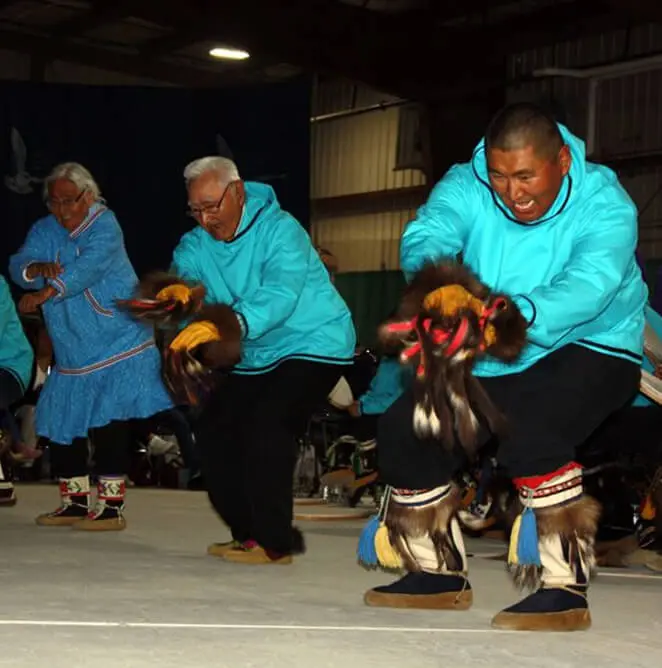


Inuit Regions of Canada
There are four Inuit regions in Canada, collectively known as Inuit Nunangat. The term “Inuit Nunangat” is a Canadian Inuit term that includes land, water, and ice. Inuit consider the land, water, and ice, of our homeland to be integral to our culture and our way of life.
Inuvialuit Settlement Region (Northwest Territories)
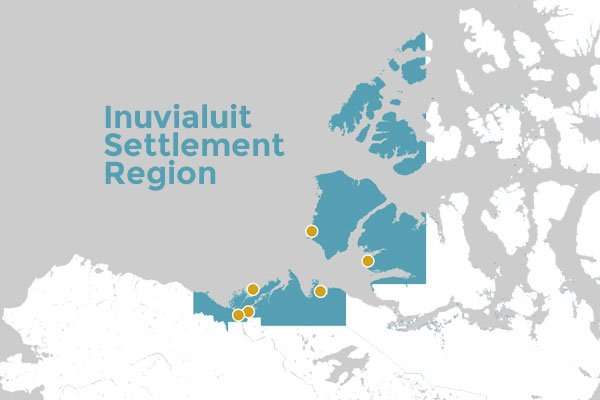
The Inuvialuit region comprises the northwestern part of the Northwest Territories.
In 1984, the Inuvialuit, federal and territorial governments settled a comprehensive land claims agreement, giving Inuvialuit surface and subsurface (mining) rights to most of the region. The Agreement ensures environmental protection, harvesting rights and Inuvialuit participation and support in many economic development initiatives.
Inuvik is the largest community in the region and is also the regional administrative center.
Economic conditions in the Inuvialuit region focus on oil and gas development, diamond mining and transportation, but the region is also on the verge of significant economic development in the construction of a major natural gas pipeline.
Inuvialuit speak Inuvialuktun
The Inuit of this region are known as Inuvialuit and their mother tongue is Inuvialuktun, one of several dialects of the Inuit language.
Nunatsiavut (Labrador)
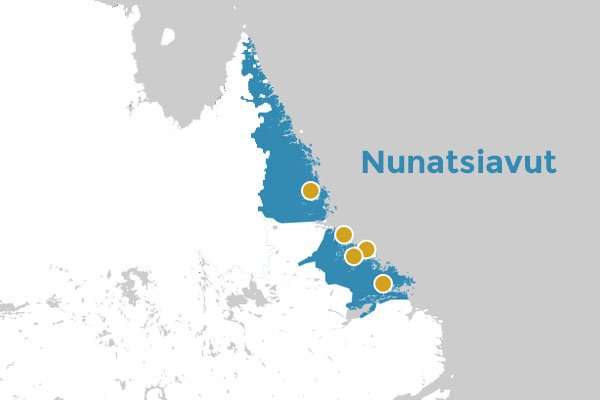
On December 6, 2001, Governor General Adrienne Clarkson proclaimed an amendment to the Canadian Constitution, officially changing Newfoundland’s name to Newfoundland and Labrador. The name change acknowledges the distinction of the Labrador region of the province. The Inuit region of Labrador is called Nunatsiavut.
Approximately 4,500 Inuit live along the Labrador coast, primarily in five communities. Nain is the biggest Inuit community in Labrador, and is also the administrative center, with a population of 900.
Wildlife harvesting continues to dominate the Inuit diet and regional economy. Government and service industries are Nunatsiavut’s biggest employer, but the Voisey’s Bay nickel mine is expected to boost the local economy in years to come by employing Inuit from nearby areas.
The Nunatsiavut Government officially came into being on December 1, 2005. It has responsibility for economic development planning, preserving Inuit culture and implementing social programs.
The legislative capital is in Hopedale, while the administrative capital is in Nain.
Nunavik (Quebec)
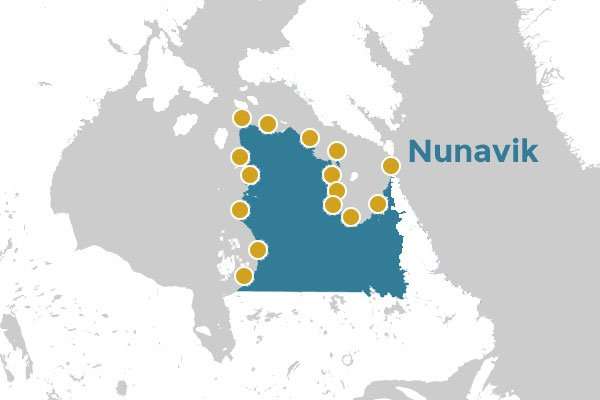
The area in northern Quebec inhabited by Inuit is known as Nunavik.
In 1971, the Quebec government announced its intention to develop a massive hydroelectric project flowing into James Bay. The James Bay Project was developed without consultation or consent of Inuit and Cree who had lived and used the area for thousands of years. The James Bay Project had the potential to irrevocably damage the land and wildlife, resources upon which the people depended.
In response to the announcement, the newly formed Northern Quebec Inuit Association and the Grand Council of the Cree of Quebec took the provincial government to court to stop development. In 1973, the Inuit and Cree won an interlocutory injunction, effectively halting construction. Quebec responded by announcing it would negotiate land claims with the Aboriginal groups. A week later, the court ruling was overturned.
The result for the Inuit of Nunavik was the first modern comprehensive land claims agreement in Canada, called the James Bay and Northern Quebec Agreement, signed in Quebec City on November 11, 1975.
Some 9,500 Inuit live in 14 communities along the eastern coast of Hudson’s Bay and Hudson Strait. The largest community in the region is Kuujjuaq, with a population of approximately 1,600.
The Kativik Regional Government is responsible for the delivery of municipal services and infrastructure in the communities. The Kativik School Board is responsible for the administration and delivery of education. Health services to Nunavik residents are managed by the Nunavik Regional Board of Health and Social Services.
Traditional hunting and fishing is a crucial food source for the Inuit of Nunavik. The transportation and service industries, along with tourism and mining are important components of the local economy.
Nunavut

On April 1, 1999, Nunavut became Canada’s newest territory. The area, once part of the Northwest Territories, is one-fifth of Canada’s landmass. Some 25,000 Inuit reside in 26 communities, with Iqaluit as its capital. Nunavut is divided into three regions, Qikiqtaaluk in the east, Kivalliq in the central Arctic along the western coast of Hudson’s Bay, and Kitikmeot in the west.
The territorial government of Nunavut incorporates traditional values and beliefs into a contemporary governing system. Inuktitut is an official language of government, along with French, English and Inuinnaqtun.
Nunavut’s economy, like that of the other regions, is based on renewable resources, arts and crafts, both on and offshore fisheries and tourism. Government is the largest employer in the territory, followed closely by the private sector and service industries.
Upon its creation, Nunavut inherited legislation from the Northwest Territories government and is now in the process of drafting a slate of new bills. Made-in-Nunavut laws include an Education Act, Official Languages Act and Inuit Language Protection Act.


