
Inuit Approaches to Suicide Prevention
Suicide is among the 10 leading causes of death in Canada. Inuit suicide rates are more than 11 times higher than the Canadian rate, according to Health Canada. And 83% of these are people under 30 years of age.
Communities are working with Inuit organizations, governments and non-government organizations in the four Inuit Land Claim Regions, to increase supports for coping, promote resiliency and raise awareness, so Inuit know where to go for help and how to help when asked. This backgrounder describes some of these activities taking place in Inuit communities; some facts about Inuit in Canada; Inuit suicide rates, protective factors and causes of suicide; and provides some information for assistance and funding.
Inuvialuit (Northwest Territories)
- In Tuktoyaktuk a group of youth are participating in an ASIST (Applied Suicide Intervention Skills Training) course. Two trainers are accompanying the youth on a three day river trip, incorporating on-the-land experience with the training.
Nunavut
- Isaksimagit Inuusirmi Katujjiqatigiit, the Embrace Life Council funds community events on September 10th , which is called “Celebrate Life” day in Nunavut. For 2008, the Council is offering $300 in support to each community that holds an event. The Council partners with Inuit communities, territorial government and others to develop and coordinate culturally relevant information, training and raise awareness and funding for suicide prevention.
- In Cambridge Bay last year, two youth leaders, inspired by the Aboriginal Suicide Prevention cross-Canada walk, arranged youth workshops with support from social workers and educators; organized a community walk and created a “comment wall” in the elementary school to allow participants to express their feelings after the walk.
Nunavik (Northern Quebec)
- The Nunalituqait Ikajuqatigiitut program offers workshops on trauma, addiction and suicide for leaders and frontline workers in Nunavik communities.
- The Saputit Youth Association organized a project for the past three summers, where a group of Inuit youth traveled by qajaaq (kayak) around the coast of Nunavik, bringing a message of “Living Life”. This August, the final leg of the journey commenced. Funded by the province of Québec and regional Inuit organizations, this project is featured in the spring 2007 issue of ITK’s Inuktitut magazine, now online.
Nunatsiavut (Labrador)
- Spiritual drumming groups have been in Happy Valley-Goose Bay and Nain, which focus on positive thinking, forgiveness, and healing from residential schools.
National Inuit or Aboriginal Organizations
Inuit Tapiriit Kanatami
Inuit Tapiriit Kanatami (ITK) is a national Inuit association representing Inuit across Canada. Our Department of Health and Environment works with Inuit organizations, governments and other stakeholders to develop policies, plans and programs for the well-being of Inuit. ITK provides for a Suicide Prevention Coordinator to work with The National Inuit Youth Council (NIYC), along with other staff who work on suicide prevention and mental wellness. The holistic, strength-based Inuit approach to suicide prevention strongly influenced the draft Alianait Action Plan for Inuit mental wellness. ITK is also working to ensure Inuit projects funded under the National Aboriginal Suicide Prevention Strategy are documented and evaluated in a way that is useful to Inuit. On the international scene, ITK sits on all Suicide Prevention Working Groups along with the Inuit Circumpolar Council and NIYC.
Pauktuutit Inuit Women of Canada
Pauktuutit supports the involvement of Inuit women in local, regional and national activities to advocate for social, cultural, political and economic innovation. Through projects which are focused on Inuit specific needs in the areas of abuse prevention, maternal and child health, sexual health and community and healthy living, Pauktuutit contributes to solutions and programs which will help build healthy individuals, families and communities.
National Inuit Youth Council
The NIYC and partners have established the Youth Media Team (YMT), which includes a group of young volunteers who are helping to improve communications for and amongst Inuit youth. Some of the projects the YMT will be tackling over the coming year include: National Inuit Youth Magazine, Comic Book project, Multi-Media Training for Inuit youth, and activities included in the Inuusivut Project. A detailed YMT backgrounder and proposal is being developed to identify next steps and guide a full-scaled implementation of the YMT.
The Ajunnginiq Centre at the National Aboriginal Health Organization (NAHO)
The Ajunnginiq Centre at NAHO focuses on Inuit health and wellness and has produced a series of resources on mental health, including: Suicide Prevention: Inuit Traditional Practices that Encouraged Resilience and Coping; Resilience: Overcoming Challenges and Moving on Positively; What is Mental Illness?; and Ikajurniq: Basic Counselling Skills. In May 2008, the Ajunnginiq Centre and several partner organizations will broadcast a live TV show about Inuit youth resilience and coping skills on the Aboriginal Peoples Television Network.
The National Aboriginal Role Model Program at NAHO celebrates the accomplishments of Inuit, First Nations, and Métis youth aged 13 to 30. “Lead Your Way!” inspires Aboriginal youth to strive to reach their goals. One of the program’s objectives is to promote a healthy lifestyle and self-esteem. Throughout the year, role models visit communities to share their stories with other Aboriginal youth. Invite a role model to your conference, workshop or event.
Inuit in Canada
There are approximately 55,000 Inuit living in Canada, according to recent estimates from Statistics Canada. The majority of Inuit (over 80%) live in 53 communities spread across two provinces and two territories. Over 90% of these communities are accessible by air only. Inuit communities are located in four Land Claim Regions:
- Nunatsiavut (Labrador)
- Nunavik (Northern Quebec)
- Nunavut Territory
- Inuvialuit Settlement Region (Northwest Territories)
- Inuit also live in southern Canada.
The Inuit population is the youngest in Canada, with 39% under the age of 15; in Canada, 19% are under age 15. Not only is the Inuit population very young, it is growing a rate of 12.1% in the years 1996-2001, compared to the rate of 3.9% for the entire population of Canada.1 The youth and the growth rate of the population impact on health issues, capacity and needs of Inuit when compared to other Aboriginal groups and the rest of Canada.
Suicide in Inuit communities2
According to 2001 Census data, the national Inuit suicide rate is 135 per 100,000 population, or more than 11 times higher than the overall Canadian rate of 12 per 100,000 population. It is not possible to cite a national suicide rate for Inuit as provincial death certificates do not identify ethnicity. Health Canada estimates the following suicide rates for Inuit regions from1999 to 2003:
- Nunavik – 181 per 100,000
- Nunatsiavut – 239 per 100,000
- Nunavut – 120 per 100,000
- Inuvialuit – 61 per 100,000
85% of Nunavut suicides are males, the majority in the 15-24 age range. In one Nunavut region, from 1999 to 2003, young Inuit men between the ages of 14 and 24 committed suicide at an annual average rate of 280 per 100,000. 3 These tragically high figures appear to be on the increase, and the average age is dropping. The number of suicide deaths in Nunavut and Nunavik has more than doubled in the past decade.4
While the suicide rate for Inuit women is lower than for Inuit men, it is far above the 2001 Canadian average of 4.9 per 100,000. The rate for Inuit women in Nunavut in 2001 was 24.6 per 100,000 and in Nunavik, 52.4 per 100,000.5
Protective Factors
The NAHO Ajunnginiq Centre’s 2006 report on suicide prevention drew on the traditional knowledge of Elders in each of the four Inuit regions. Inuit elders believe the coping and resilience skills and values they used in the past are just as necessary in today’s world, including patience; perseverance; love and caring; communication; awareness of self and others; confidentiality and respect for others; and personal responsibility to youth. They identified certain coping skills as especially important in Inuit culture:
- Paying attention to each other’s needs
- Focusing on helping others as a way of promoting connection and a sense of usefulness
- Doing something productive, active and healthy
- Talking things out
- Solving conflicts with others, and
- Accepting that life is not always easy but that tomorrow can be better
Another study underway is Qaujivallianiq inuusirijauvalauqtunik, an Inuit-specific, comprehensive, territory-wide follow-back study to collect and analyze 300 Inuit life stories, including 100 people who have never attempted suicide, 100 who have, and 100 who completed suicide. The purpose is to better identify risk factors and assist in developing more effective prevention approaches. The study was designed by a reference group, including the Embrace Life Council, RCMP, Nunavut Tunngavik Incorporated (the Inuit Land Claim organization), the National Inuit Youth Council, the Government of Nunavut and the clergy, with the McGill Group for Suicide Studies.
Causes of Inuit suicide
Some common factors exist in Aboriginal suicides6; however, some factors are specific to Inuit:
- Lack of coping skills (relationship break-ups frequently trigger suicides by Inuit youth);
- Barriers or lack of access to mental health treatment;
- Loss of control over land and living conditions;
- Socio-economic factors in the community7 (non-medical determinants) including:
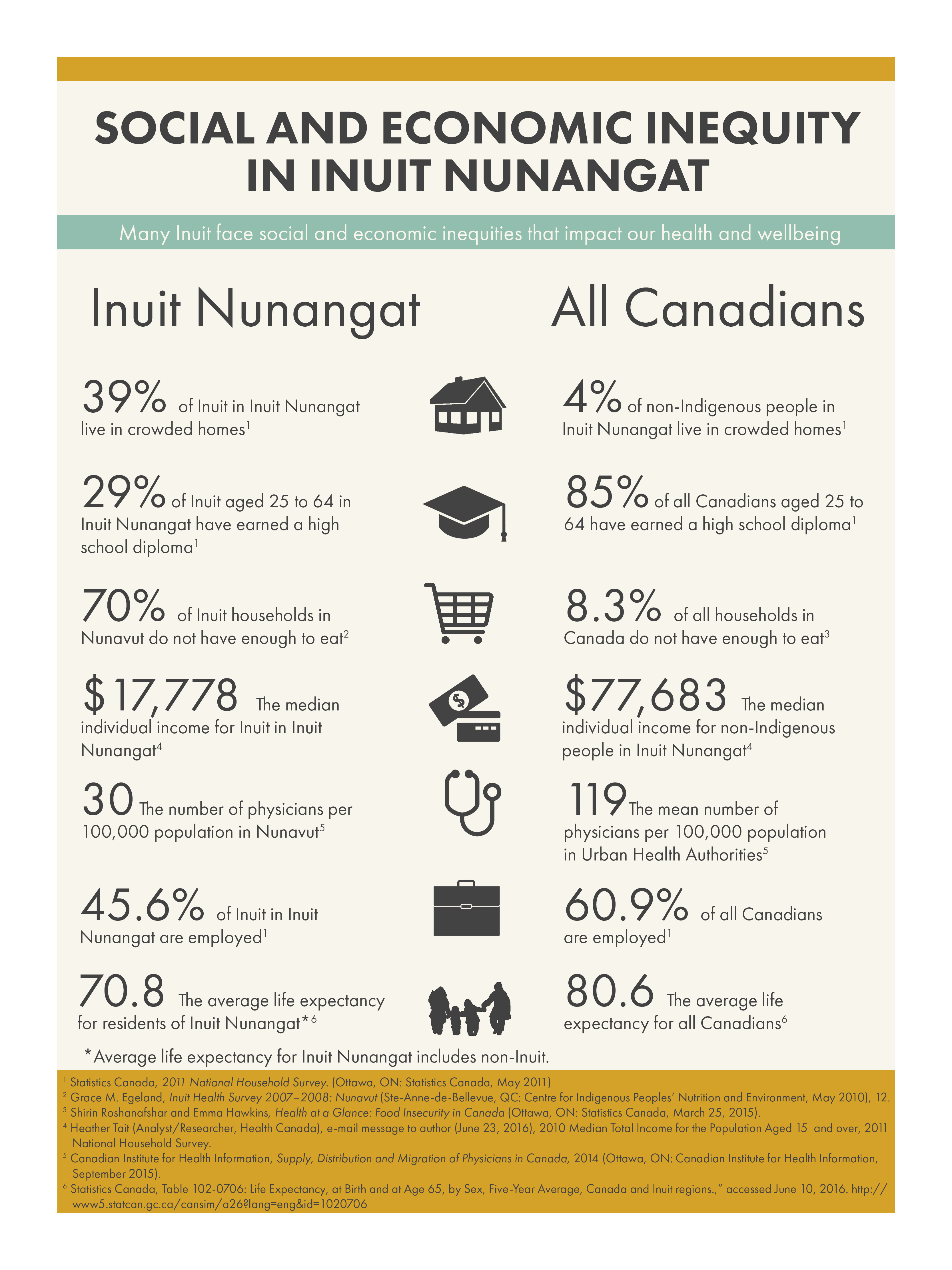
- high poverty rates; in 2001, the average personal Inuit income was only 66% of the average Canadian’s personal income, although food may cost from 2 to 3 times more than in Southern Canada
- housing problems: in 2001, 20% of Inuit households were crowded, compared to less than 2% of non-Aboriginal Canadians
- low levels of education and literacy; only ½ of Inuit have completed high school
- lack of employment: in 2006 only 37% of Inuit were satisfied with job opportunities in their communities; in 2001, unemployment rates for Inuit men were nearly 30% higher than for other Canadian men
- Inadequate sanitation and water quality; in one region, over 40% of Inuit consider their drinking water unsafe year-round
- Intergenerational trauma resulting from historical events, for example:
- forced relocations to permanent settlements which ended nomadic life and in some cases, separated extended families completely
- sled-dog slaughters impaired Inuit hunters’ abilities to provide for their families and obliged them to remain in settlements
- enforced boarding school attendance or lengthy treatment for tuberculosis or other illnesses in hospitals in southern Canada, caused damage to family relationships through separation and language loss
- Loss and/or changes to values, beliefs and lifestyle from various causes; for example, climate change leaves Inuit hunters unable to trust their traditional methods of predicting weather and animal migration patterns;
- Individual history (e.g. experiencing traumatic events such as the early loss of a parent; sexual abuse; experiencing or witnessing violence, etc.);
- Alcohol is frequently cited as a major factor in Aboriginal suicides. However, the Nunavut coroner’s report for 1999-2003 and the coroner’s data cited in the Health Canada Northwest Territories study for 1994-1996 both report that in the approximately 80 per cent of suicide deaths in which toxicology testing was possible, alcohol was not a factor in approximately 70 per cent of cases;
- Family or caretaker history of suicide, or suicide “clusters”, where a number of suicides occur over a short time period.
Some Sources of Help in Inuit Regions
Nunatsiavut (Labrador)
- Nain Help - Line Phone: (709) 922-2277
Nunavik (Northern Quebec)
- Nunavut Kamatsiaqtut Help Line, operated out of Nunavut, also takes calls from people living in Nunavik.
Phone: (867) 979-3333, or toll-free 1-800-265-3333.
Every night, 7:00 p.m. to midnight.
Nunavut
- Nunavut Kamatsiaqtut Help Line - Phone: (867) 979-3333, or toll-free 1-800-265-3333.
Every night, 7 p.m. to midnight. - Keewatin Crisis Line - Phone: (867) 645-3333
Monday to Friday 7 p.m. -10 p.m. - Kugluktuk Awareness Centre - Phone: (867) 982-4673
Kid’s Help Phone
- Phone: 1-800-668-6868
Inuvialuit (Northwest Territories)
- Inuvik Suicide Crisis Line - Phone: (867) 777-1234
Monday to Friday, 5 p.m. - 8:30 a.m.
- Helpline Western Arctic - Phone: 1-800-661-0844
7 p.m. - 11 p.m.
To access National Aboriginal Youth Suicide Prevention Strategy funding, contact a Suicide Prevention Regional Coordinator, in the First Nations and Inuit Health Branch of Health Canada:
In the Inuvialuit Region, contact Patty Zeman, Tel: (613) 948-4652
In the Nunavut Region, contact Maureen Connors Tel (613) 946-6832 fax (613) 946-1823
In Nunavik,contact France Racette, Regional Coordinator, Community Based Programs
Tel (514) 283-1559 fax (514) 283-8067
In Nunatsiavut, contact Kevin Ryan, Atlantic Regional Coordinator
Tel (902) 426-2135 fax (902) 426-8675
Footnotes
- 2001 Census data, StatsCan
- In Nunavik, from 1973 to 2004, there were a total of 188 deaths by suicide, according to statistics from the Nunavik Regional Board of Health and Social Services.
In the Nunatsiavut region of Labrador, there have been 55 suicides between 1993 and 2005, according to the Nunatsiavut Department of Health and Social Development.
In Nunavut, from April 1, 1999 to August 29, 2005, there were a total of 177 suicides, according to statistics from the Office of the Chief Coroner, Nunavut. - Hicks, J. “Nunavut Kiglisinaiqtiit; Evaluation and Statistics; Presentation to the Founding Conference of the Nunavut Suicide Prevention Council” Iqaluit, 2004
- Office of the Chief Coroner, Nunavut; Nunavik Regional Board of Health and Social Services
- Hicks, J. 2004
- As cited in: “Suicide Prevention: Inuit Traditional Practices that Encouraged Resilience and Coping”, Ajunnginiq Centre, National Aboriginal Health Organization Report September 2006:
Kral, M. “Unikkaatuit: Meanings of Well-Being, Sadness, Suicide and Change in Two Inuit Communities.” Report to Health Canada, February 2003; White, J. and Jodoin, N. “Aboriginal Youth: A Manual of Promising Suicide Prevention Strategies.” Calgary: Centre for Suicide Prevention 2004; and Chenier, N.M. “Suicide Among Aboriginal people: Royal Commission Report.” Ottawa: Library of Parliament Parliamentary Research Branch, February, 1995 - Statistics Canada, March 2006. Harvesting and community well-being among Inuit in the Canadian Arctic: Preliminary findings from the 2001 Aboriginal Peoples Survey – Survey of Living conditions in the Arctic